Midterms are weeks away. Can families still talk politics?
The story
The U.S. midterm election is Nov. 3, 2026, and the country feels tense. A new poll shows President Trump's approval at the lowest point of his second term. Meanwhile, protests, immigration arrests and a Supreme Court fight over TV ad prices are stirring strong feelings, and surveys show politics is straining many friendships and families.
What happened
A midterm is the election held in the middle of a president's four-year term, when voters choose members of Congress. On Oct. 8, the Pew Research Center released a survey of 5,062 adults taken Sept. 28 to Oct. 4. It found 30% approve of the job Trump is doing and 68% disapprove. Among registered voters, Democrats lead by 8 points in which party they want to control the House. Pew also found 63% of voters say Trump is a factor in their vote: 44% see their vote as against him and 19% as for him.
There is also a legal fight over TV ads. Federal law gives candidates a station's "lowest unit charge," meaning its cheapest ad price, in the 60 days before a general election. In March, the FCC, the agency that oversees broadcasters, said political parties' coordinated ads and some joint fundraising committees, which raise money for several campaigns together, could get that price too. Four Democratic congressional candidates challenged this. An appeals court, the 4th Circuit, struck down the guidance in August. On Sept. 4, the Supreme Court paused that ruling, saying the appeals court likely lacked jurisdiction because the full FCC had not acted yet.
On Oct. 7, a 2-1 appeals panel ordered the FCC to decide the challenge by noon Oct. 9. The next day, Solicitor General D. John Sauer asked the Supreme Court to block that order, calling it a "flagrant abuse." Chief Justice John Roberts temporarily blocked the deadline and asked the challengers to respond by Oct. 10.
Outside the courts, the No Kings coalition plans "No Kings: Vote Early" events on Oct. 17, which organizers call a nonpartisan early-voting day. Immigrant advocates report a surge in ICE arrests in California's Central Valley. On Oct. 10 in Houston, a man was hospitalized after being struck by an ICE vehicle during an enforcement operation, according to the Houston Chronicle and the Harris County Sheriff's Office.
Who’s involved
The ad case involves the FCC, led by Chair Brendan Carr; Republican campaign committees (the NRSC and NRCC); the Democratic challengers; and the Campaign Legal Center, a watchdog group backing them. The No Kings coalition includes Indivisible, 50501, Public Citizen and Black Voters Matter Fund. The Department of Homeland Security and ICE carry out immigration enforcement.
Why people are so upset
On ad prices, the administration says the guidance gives "the same benefit to all sides" and courts should not rewrite rules weeks before an election. Republican committees say the appeals court caused confusion. The challengers say the law gives the discount only to a "legally qualified candidate." The Campaign Legal Center warns it lets billionaire-funded groups use a discount meant for candidates. The Washington Post called the Sept. 4 order a likely near-term win for Republicans, who have far more party money.
On immigration, DHS says it targets the "worst of the worst" criminals. Advocates say enforcement has sharply increased, families and lawyers are being kept from detainees, and some people fear going to vote.
Trump also stirred debate about a third term. He said "the law is very strong" but has posted "Trump 2028" material. Fox News reports most constitutional scholars say a third term would not work under the 22nd Amendment.
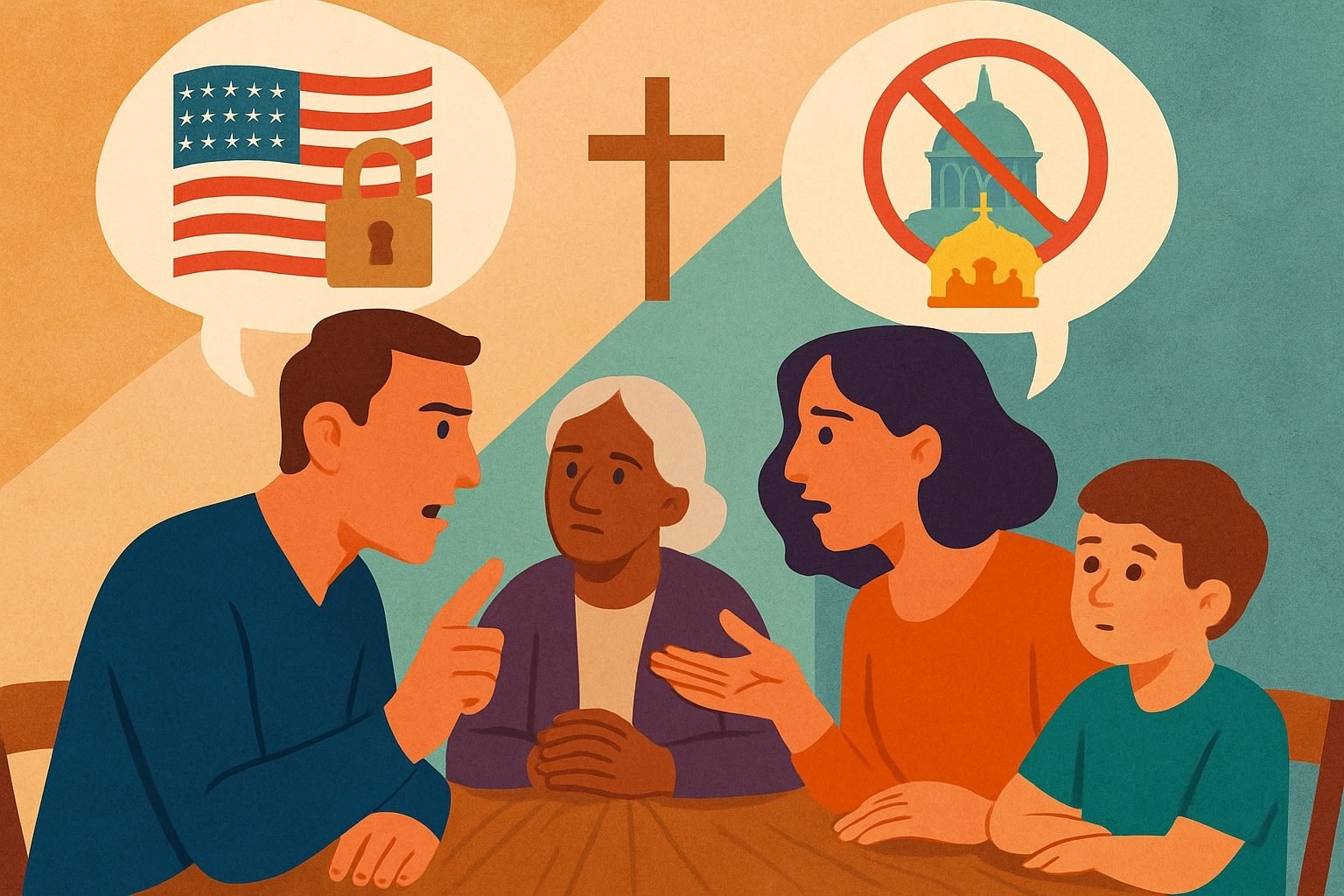
All this reaches into homes. A UC Irvine study found 37% of Americans say they have lost a relationship over politics, most often a friend. A Florida State University brief says more than 60% now find political talk with people they disagree with stressful, up from about 45% in 2013.
What we don’t know yet
No final ruling says whether parties qualify for the discount. We don't know how the Supreme Court will rule on the new request or when the FCC will decide. DHS has not confirmed a reported 45-day California operation, and advocates' claims about detainees are unverified. No Kings crowd numbers are organizers' own estimates.
The good
There is real love underneath a lot of this tension. People care about their country, about fair elections and about their neighbors. Some worry that one side will gain an unfair edge in TV ads before Nov. 3. Others worry that courts are changing the rules weeks before an election. Some long for safe communities and for dangerous criminals to be removed. Others grieve for immigrant families who are afraid, and for a man hospitalized in Houston after being struck by an ICE vehicle. Groups planning early-voting events want every eligible citizen to take part. These are not silly concerns. They come from a longing for justice, safety and a voice, which God built into us.
It is also good that so many people still care about their relationships. More than 60% now find political talk with people they disagree with stressful, but that stress often means we do not want to lose the people we love. Family voices like Braver Angels and Weill Cornell Medicine point to a wise path: keep hearts open, focus on shared values, and set kind limits when a conversation gets too heated.
The bad
The danger is letting a three-week news cycle shrink a whole person into a party label. A UC Irvine study found 37% of Americans say they have lost a relationship over politics, sometimes a family member. When a parent, sibling or friend becomes 'the other side,' we start treating someone made in God's image as an enemy to defeat instead of a neighbor to love. Contempt, mockery and assuming the worst about motives can do more damage at the dinner table than any poll or court ruling.
There is a quieter danger too: putting our hope, fear or identity in an election outcome. Approval numbers rise and fall, court cases drag on, and many questions in this story are still unresolved. If our peace depends on who wins in November, we will be anxious either way. And avoiding every hard conversation out of fear is not the same as peace. Sometimes love speaks, carefully and humbly, and sometimes love wisely waits.
What the Gospel says
In today's reading, Paul writes to ordinary households in Ephesus, parents and children, workers and masters, and then reminds them that "our struggle is not against flesh and blood" (Ephesians 6:12). That changes how we talk politics at home. Your uncle, your teen or your coworker is not the enemy. Paul even tells fathers not to "provoke your children to wrath" (Ephesians 6:4), a good word for parents who want to talk about the news without crushing their kids. The armor he describes includes having "your feet fitted with the readiness of the gospel of peace" (Ephesians 6:15). We step into tense conversations carrying peace, not ammunition.
That armor is not ours to invent. As today's lesson shows, the breastplate of righteousness and helmet of salvation come from Isaiah 59, where the LORD saw that no one could fix the barriers sin had built, so "His own arm brought salvation" (Isaiah 59:16). Jesus is that Redeemer. He brought "Peace, peace to those far and near" (Isaiah 57:19), and He can hold together a family that votes differently. We stand in His righteousness, so we do not need to win every argument to feel secure.
Isaiah 58 warns Israel against religion that looks busy but lacks love. God's chosen fast is "to share your bread with the hungry, to bring the poor and homeless into your home" (Isaiah 58:7). Whatever our views on policy, believers should care for the actual people in this story: frightened families, officers doing hard work, an injured man in Houston and voters who feel unheard. And God's promise holds for anxious hearts in an election season: "The LORD will always guide you" (Isaiah 58:11).
James writes to scattered believers facing trials, and he gives a plain rule for heated moments: "Everyone should be quick to listen, slow to speak, and slow to anger, for man's anger does not bring about the righteousness that God desires" (James 1:19–20). Paul adds, "Let your speech always be gracious, seasoned with salt, so that you may know how to answer everyone" (Colossians 4:6). Grace does not mean having no convictions. It means sharing them in a way that honors the person across the table.
So yes, families can still talk politics. Ask questions before giving answers. Name what you agree on. Pray together for "kings and all those in authority" (1 Timothy 2:2), whoever they are. Vote with a clear conscience. And when a conversation starts to burn, it is wise and loving to step back, because the relationship is worth more than the point.
Key passages: Ephesians 6:10–18 · Isaiah 58:6–11 · James 1:19–20 · Colossians 4:5–6 · 1 Timothy 2:1–4
Let’s pray
Father, You see our tense nation and our tense dinner tables. We pray for families and friends strained by politics, for those who have lost a relationship, for immigrant families living with fear, for the man injured in Houston, and for the officers who carry out hard duties. We pray for the President, for justices and judges, for FCC commissioners, for lawmakers and candidates, and for parents guiding their children. Give them the wisdom that comes from heaven, which is "pure, then peace-loving, considerate, submissive, full of mercy and good fruit, impartial and sincere" (James 3:17). Help every voter choose with a clear conscience. Teach us to be quick to listen and slow to anger. Clothe us in Your armor, so we remember that our neighbors are not our enemies. Lord Jesus, You are our peace; let our words be full of grace and truth, and make our homes places of welcome.
Amen.
Comments